
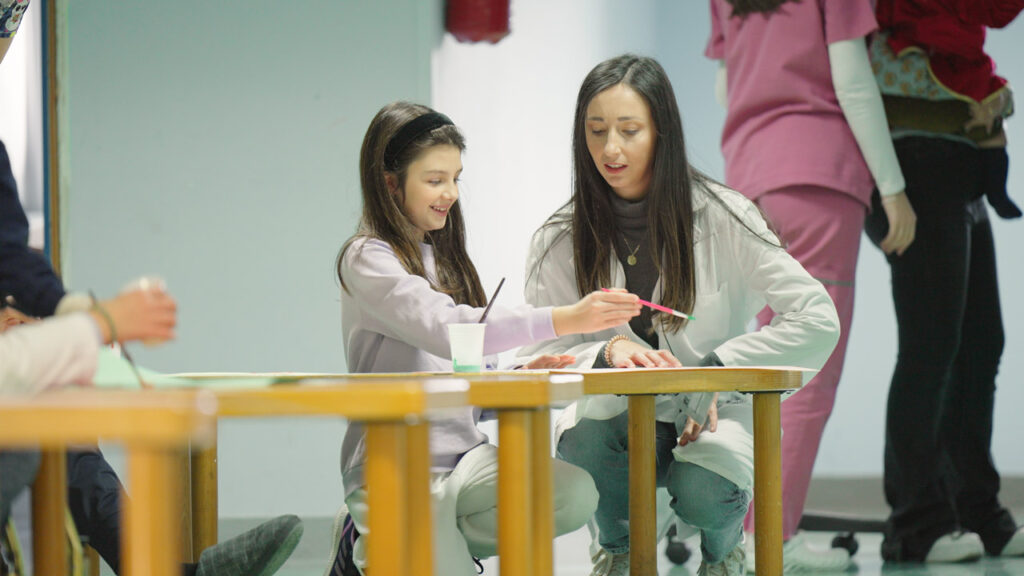
The Atelierista is an art and education professional who works to enhance creativity, freedom of expression, and individual learning rhythms, whether with children, teenagers, or adults.
Unlike a teacher or educator, the Atelierista is an expert in artistic (such as music) and digital languages.
With a sensitive eye and guided by a strong pedagogical idea, they recognize the potential for meaningful experiences in contexts (whether structured spaces or everyday environments) and materials.
The atelier is thus an invitation to independent exploration, to the conscious use of tools and languages that aim to enhance imagination, personal research, and the collective construction of meaning.
The ateliers take shape from ideas born of reflections shared with teachers and other education professionals, as well as from episodes experienced in the field —spontaneous discoveries, unexpected questions, and insights from children and young people —to enrich educational projects.
Taking care of every experience is one of the fundamental tasks of the Atelierista.
Each atelier aims at personal growth through the authentic expression of the self, with full respect for the uniqueness of the participants who, thanks to multiple languages, have the opportunity to recognize themselves in what they think and do.
At the heart of their educational approach is the generative question —a powerful, open, curious, and never-judgmental tool for dialogue. It expresses care and dedication because it stems from the desire to get to know the other through their creations, the result of their visions, knowledge, and interpretations of the world.
Training and skills
The training of the Atelierista is not limited to a traditional academic path, but is built up over time through direct practice and constant updating.
In addition to mastering artistic techniques and digital technologies, this figure must also be able to read educational contexts and translate complex ideas into experiences accessible to all.
A thorough knowledge of materials is required, combined with an aptitude for experimentation, critical reflection, and interdisciplinary work. In fact, the Atelierista grows professionally by intertwining their skills with those of teachers, educators, families, and the experiences of children and young people themselves.
According to the ABF approach, the training of an Atelierista develops in several dimensions:
- Planning and vision: it is not easy to keep alive the principles of choice, care, and reciprocity that we mentioned earlier. This is why it is necessary to have a solid educational vision, which is refined during the planning phase, where it is essential that doubts and uncertainties also emerge.
- Monitoring and observation: during the atelier, the Atelierista must also carry out constant monitoring, aimed at observing any limitations imposed by language, materials, tools, or the time allocated for the activity.
- Documentation: the Atelierista has a duty to document the progress made during the atelier by taking care of the work produced to convey and preserve knowledge and understanding of the ‘things of the world’, to be understood and communicated through infinite languages, with ever-fresh eyes.
Whether planning with teachers to renew teaching methods or developing an idea independently, the Atelierista always carries with them a shared heritage, namely that gained through experience and that of the children and young people encountered along the way.
The role of the ABF Atelierista
The Atelierista plays a central role in the educational projects developed by the Andrea Bocelli Foundation, whose goal is to work on the development of human potential, both individual and collective, starting from the school environment and through the use of the languages of art, music, and digital technology.
Two of the Foundation’s programs fall within this scope: ABF Digital Lab and ABF Art & Music Lab, both dedicated to creating inclusive, experiential, and relationship-oriented educational contexts.
Part of these projects is developed within the pediatric hospitals belonging to the AOPI (Italian Pediatric Hospitals Association) network and the Memorandum of Understanding with the Ministry of Education and Merit, for the implementation of innovative educational projects in schools and hospitals, with the support of the Schools in Hospitals participating in the project, to ensure equal and quality education for hospitalized children.
The other area of intervention concerns schools in Central Italy, where the laboratories above are active and innovative educational environments are promoted, open to the community and based on nurturing talent, such as the ‘A. Bocelli’ Zero-Six Center in Lajatico and the schools rebuilt by ABF in the areas affected by the 2016 earthquake.
Three specific types of Atelieristas work within these programs. The ABF digital Atelierista is a professional specialized in the use of technology for education and in supporting teachers in the conscious integration of digital tools.
The ABF art Atelierista, on the other hand, prepares creative experiences that bring opportunities for authentic self-expression to life and promotes human growth through the multiple languages of art—visual, physical, and sculptural—exploring techniques and tools specific to the artistic world.
Art thus becomes a privileged channel for stimulating the imagination, supporting learning, and fostering a deeper understanding of oneself, others, and the world through various forms of art.
Last but not least, the ABF music workshop leader is a professional musician who promotes the overall development of individuals through an experiential, participatory approach to music. In their courses, musical language becomes an active tool capable of harmonizing dreams, experiences, learning, desires, and emotions, thanks to listening, harmony, and the beauty of melody, understood as dimensions in which to grow together.


